
A Look Behind The Back Pain: Understanding Herniated Discs & Other Common Culprits
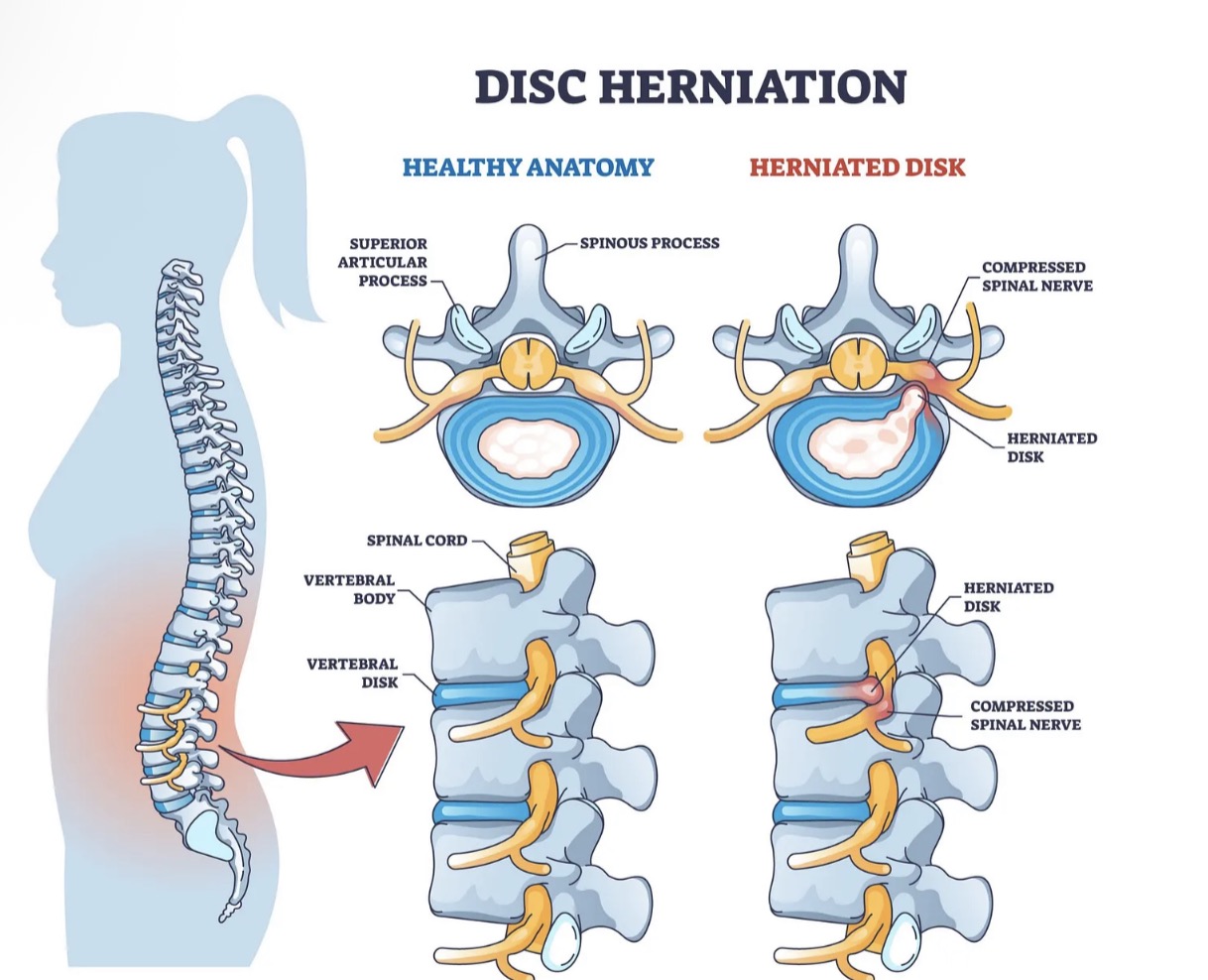
If you have ever experienced a sharp, sudden pain in your lower back while bending over, or even a sore ache that just won’t leave you alone, you must have known by now how quickly back issues can take over your life.
Our spines do an extraordinary amount of heavy lifting, but they are also extremely complex structures. When something inside goes wrong—like a disc herniation—your body immediately lets you know. Let's take a look behind the curtain to see what’s actually happening inside of your spine, and look at some common reasons that your back might be bothering you.
Herniated Discs: A Jelly Donut Drama
To fully understand a herniated disc (sometimes referred to as a slipped or ruptured disc), it really helps to visualize a jelly filled donut.
Your spinal discs are the rubbery cushions that sit in between your vertebrae (spinal bones). They consist of a tough, rubbery exterior known as the annulus, and have a soft, jelly-like center known as the nucleus pulposus (Cleveland Clinic, n.d.; Mayo Clinic, n.d.).
A herniation happens when there is a tear in the annulus, or the tough outer shell, allowing some of the “jelly” to push outward. Instead of the whole disc slipping out of place, this material may compress other spinal nerves nearby. It is also important to note that clinical presentations of herniated discs vary widely. Symptoms can vary extensively depending on the location of the disc and the total nerve compression nearby. While most herniated discs can have no symptoms and be discovered incidentally on imaging, others can cause discomfort, tingling, numbness, or radiating pain (Harvard Health Publishing, n.d.).
- The Symptoms: Symptoms vary depending on where the disc is located and which nerve is actually being affected. Some people have no symptoms at all, while others can experience numbness in back, neck, arms, or legs, and also experience tingling.
- The Cause: Natural aging, strain over time, or injuries like lifting heavy objects with improper form.
Other Common Back Problems
A herniated disc isn’t the only issue that can cause serious pain in the spine. Here are 3 other spinal conditions that can frequently cause back and nerve related symptoms.
Bulging Discs:
People tend to confuse bulging discs with herniated ones, but they have a slight difference. In a bulging disc, the outer layer known as the annulus pushes outward beyond its normal perimeter, which affects a large portion of the total circumference of the disc. In a herniated disc, a tear can form in that tough outer layer, allowing some of the nucleus pulposus to leak out. However, both of these conditions can be discovered incidentally on routine imaging, causing significant discomfort, numbness, or pain depending on their anatomical location, and the degree of nerve compression (Center for Neurosurgery, Spine & Orthopedics, n.d.).
Spinal Stenosis:
This is a condition in which the spaces within our spines start to narrow down. We can imagine it as if our spinal cord and nerves started traveling through a very narrow and hollow tube; stenosis just means that tube is slowly tightening up. It's usually caused by arthritis and bone spurs over a long time. The symptoms can vary significantly from person to person. A classic presentation of spinal stenosis involves cramping, and significant pain in the legs that gets worse with standing or walking. Symptoms can improve when bending forward or sitting down, as it opens up space in the spinal canal (Cleveland Clinic, n.d.; Mayo Clinic, n.d.).
Degenerative Disk Disease (DDD):
Despite the really scary name, this isn’t exactly a disease—it’s more a natural part of aging. As we get older, our disks start to lose their water content and start to shrink, which leads to them absorbing shocks much less effectively. This narrowing of the space between our bones can lead to inflammation and also the loss of flexibility (Cleveland Clinic, n.d.; Cedars-Sinai, n.d.).
When to see a doctor immediately:
It is vital to seek medical care if you suddenly experience a severe loss of bowel or bladder control, or any numbness in your groin and thigh area. These specific symptoms can indicate cauda equina syndrome, a neurological condition that requires immediate medical treatment (American Association of Neurological Surgeons, n.d.).
References:
- American Association of Neurological Surgeons. (n.d.). Cauda equina syndrome. https://www.aans.org/patients/conditions-treatments/cauda-equina-syndrome/
- Center for Neurosurgery, Spine & Orthopedics. (n.d.). Treatment options for a bulging disc. https://www.cnsomd.com/blog/treatment-options-for-a-bulging-disc/
- Cedars-Sinai. (n.d.). Degenerative disc disease. https://www.cedars-sinai.org/health-library/diseases-and-conditions/d/degenerative-disc-disease.html
- Cleveland Clinic. (n.d.). Degenerative disk disease. https://my.clevelandclinic.org/health/diseases/16912-degenerative-disk-disease
- Cleveland Clinic. (n.d.). Herniated disk. https://my.clevelandclinic.org/health/diseases/12768-herniated-disk
- Cleveland Clinic. (n.d.). Spinal stenosis. https://my.clevelandclinic.org/health/diseases/17499-spinal-stenosis
- Frisco Spinal Rehab. (n.d.). Non-surgical herniated disc treatment. https://friscorehab.com/conditions/herniated-disc/
- Harvard Health Publishing. (n.d.). Herniated disk: A to Z. Harvard Medical School. https://www.health.harvard.edu/bones-and-joints/herniated-disk-a-to-z
- Mayo Clinic. (n.d.). Herniated disk: Symptoms & causes. https://www.mayoclinic.org/diseases-conditions/herniated-disk/symptoms-causes/syc-20354095
- Mayo Clinic. (n.d.). Spinal stenosis: Symptoms & causes. https://www.mayoclinic.org/diseases-conditions/spinal-stenosis/symptoms-causes/syc-20352961