
Sensor Types and Company Strategies
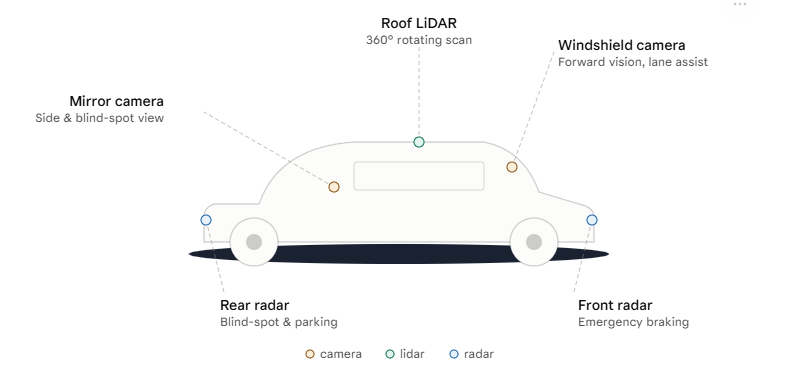
Sensors in Autonomous Driving & Future Automotive Strategies
Introduction
This website discusses the different sensor types and lists companies, grouped into Mainstream, Luxury, and Exotic brands, that have been using these sensors for basic driver assistance, such as lane assist and forward collision warning, and how they plan to shift away from this and work toward full autonomous driving. Alongside this transition, these companies are working to add more electric options to their lineups to reduce carbon emissions from gas vehicles.
1. Sensors Used in Autonomous Driving: Camera, LiDAR, Radar, and Sensor Fusion
Camera
The company known for excelling in the use of cameras is Tesla. There are pros and cons with this technology, just like any other, as expected. Starting off with the positives, camera systems are known to have great lane assist and also provide strong visual details in perfect weather conditions; however, the real struggle is when the weather conditions aren’t so perfect. These include situations like dense fog, heavy rain, dark environments, and strong glare from headlights/taillights, etc. (Vargas et al., 2021).
LiDAR
The second type of self-driving technology uses LiDAR. Though this technology is less cost-effective than cameras, it is far more capable in areas where cameras are seen to have limitations. Cameras can only show what they can see, but LiDAR can create detailed three-dimensional visual maps of the surroundings (Vargas et al., 2021). LiDAR is the more expensive option; however, the clarity and the attention to detail it gives even in tough weather conditions is what makes it stand out and compete against camera and radar systems.
Radar
Radar is very effective even in tough weather conditions such as dense fog and heavy rain. Radar Systems perform better in low-visibility conditions because radio waves are less affected by adverse weather conditions such as fog and rain (Velasco-Hernández, 2021). In terms of placement, cameras are usually placed around the vehicle, often in areas like bumpers and lights. Whereas LiDAR systems may be placed in different areas of a vehicle, and while some use moving parts, others are solid-state and contain no moving components to calculate distance and measure lanes and surroundings. On the other hand, Radar is commonly integrated into the vehicle, often behind the windshield, and is widely used in safety systems like Automatic Emergency Braking. Every automotive company uses different technologies to achieve the same goal, such as using cameras, radar, or both, depending on the depth and the distance at which the company wants to alert the driver. This is useful when the driver miscalculates distance, as the system can detect obstacles and get the car to slow down or apply brakes to avoid a fatal collision or a crash.
Sensor Fusion
This is one of the best solutions to address the concerns around self-driving cars, especially the risk of the vehicle incorrectly interpreting its surroundings. The downside of one sensor is often balanced by the strength of another. For example, cameras are not the best for poor weather conditions but are cost-effective and provide good visual details. LiDAR, on the other hand, is suitable for companies that are willing to invest more, especially when higher accuracy is desired, because LiDAR systems are more expensive than other sensing systems due to their specialized hardware and signal processing requirements. (Qian, 2025).
The ideal setup would be to combine these systems to create an autonomous vehicle with a highly reliable and effective perception system. However, one major downside of this approach is the high processing power required, as the system must continuously process and analyze large volumes of data from multiple sensors in real time. In conclusion, fusion systems work by utilizing the combination of cameras, LiDAR, and Radar to ensure the risk is minimized and the safety is maximized. However, the downside is the cost to get this done, and also, sometimes, there can be conflicting readings, calibration errors, and latency issues leading to an effect on reliability and safety.
2. Different Types of Automotive Companies and Plans/Strategies for Their Future
Mainstream Manufacturers
-
Ford:
Ford is actively working to produce more electric vehicles and optimize hands-free driving experiences to shift from the traditional driver-and-passenger layout to a more vehicle-led driving experience, as shown on its website. So far, Ford offers driver assistance, as seen with BlueCruise, but in the future, they're working toward autonomous driving to stay relevant in the autonomous world. Along with these innovative steps, they work on adding more electric options to their lineup as well. (Ford)
-
Chevrolet:
Chevrolet is working towards an all-electric vehicle lineup, and they are looking to expand it across their sports models as well since having a set of electric motors boosts horsepower and increases overall performance. Chevrolet has already released vehicles with an electric powertrain, as seen with their Equinoxes, and a limited inventory of electric trucks with the Silverado, which is quickly expanding to other vehicles such as the Chevrolet Silverado RST and Z71 trims as well. (Chevrolet)
-
Honda:
Honda is focusing on creating a world where accidents are a thing of the past, starting with the year 2040. Honda’s vision is like no other. They focus on the continuous innovation of reliable, trustworthy engines to power their vehicles until the world is ready to go full electric, since they don’t only make cars and trucks; they make engines that can be put into dirt bikes, 4X4s, side-by-sides, and ATVs. So far, they have gas and hybrid vehicles, although they attempted an all-electric model with the Prologue; they discontinued it after 2026 to redesign and bring it back once it is up to their standards again. Honda stated that they are working towards reduced carbon emissions by incorporating more electric vehicles into their lineup to further enhance their reliability and performance.
-
Toyota:
Toyota’s main focus is making all-electric vehicles, as seen with their new 2026 and 2027 lineup. This transition started as just hybrid and quickly transitioned into making electric vehicles in huge numbers. Toyota focuses on encompassing all the benefits of hybrids, plug-ins, and all-electric models to achieve diversity and gain the largest audience in the new generation of automobiles. Toyota has a great reputation as the most reliable automotive company in the world, so they prioritize maintaining that and expanding to meet the new requirements for vehicles, especially to reduce carbon emissions.
-
Dodge:
Dodge has both gas and all-electric vehicles, as seen with their Dodge Chargers and Dodge Durango SRT vehicles for customers still interested in the gas models. Dodge released the all-electric Charger and Challenger, which were quickly discontinued and recalled, so seeing someone who had one was a rare sight to see, but now they are reengineered so that they play fake engine noises from the exterior speakers to make them safe for pedestrians and still sound like gas vehicles through the use of a Fratzonic Chambered Exhaust to make it feel more like a high-performance gas vehicle.
Conclusion
In conclusion, this website has covered several important points from the different sensor types that the main automotive companies are using and a detailed description of what they plan to incorporate and introduce as part of their lineups going forward to align with their new goals to become a better company than they already are. This shows that these companies are looking to improve and make the world a safer, more convenient environment for humans with the help of robots in the automotive space.