How do countries use economic and cultural influence (soft power) to achieve political goals?
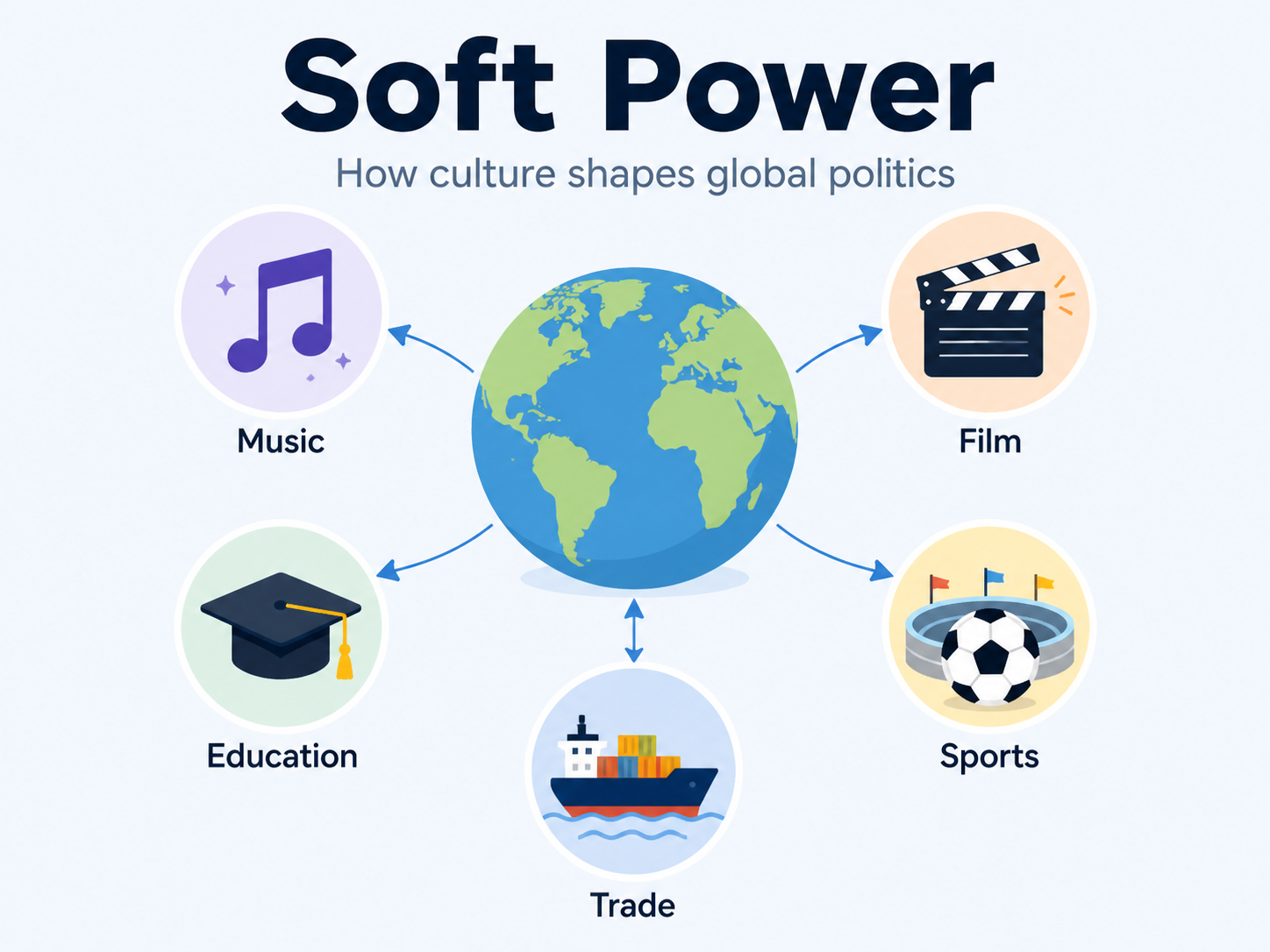
Soft Power: How Culture Shapes Global Politics
“What if a song—not a soldier—decided tomorrow’s alliance?” Wouldn’t geopolitical situations be happily ever after? Today, countries increasingly use economic and cultural levers—music, movies, education, media, and sport—to legitimize agendas, isolate rivals, and set global norms without open coercion.
A single pop song can ripple through policy. When BTS reached No. 1 on Billboard with Dynamite, Korea’s culture ministry estimated an economic effect of roughly $1.5 billion and nearly 8,000 jobs created from music sales and related exports such as cosmetics and food. Beyond one release, Hyundai Research Institute has estimated BTS’s annual boost to the Korean economy at over $4.6 billion, driven by tourism, merchandise, and brand value. In other words, fans become buyers—and sometimes visitors—making culture a trade and tourism strategy.
China blends cultural outreach with economic power. Confucius Institutes, which fund language classes and cultural events abroad, numbered about 496 worldwide, along with 757 Confucius Classrooms, by 2023. These partnerships help create long-term familiarity with China. At the same time, Beijing’s Belt and Road Initiative finances ports, railways, and roads—projects that can translate into political leverage. Sri Lanka’s Hambantota port is a key example: after debt troubles, the port was leased to a Chinese firm for 99 years in 2017, a deal that continues to shape regional diplomacy. Whether seen as “debt-trap” coercion or hard economics, the political signal is clear: economic ties can become strategic ties.
India’s film industry shows how storytelling opens doors. Bollywood films have travelled widely, especially in China. Aamir Khan’s Dangal earned roughly ¥1.3 billion, around $190 million, in China, making it one of the country’s major box-office successes. A story about Indian women wrestlers became a topic of conversation from Beijing to Chengdu. This kind of cultural familiarity lowers walls: it becomes easier to support trade, visas, or research partnerships with a country whose films people admire.
Scholarships are another powerful tool of soft power. The U.S. Fulbright Program has built global networks of scholars, leaders, and professionals. Its alumni include more than 40 heads of state or government, over 60 Nobel laureates, and around 90 Pulitzer Prize winners. These relationships often outlast political leaders and policies, helping support scientific cooperation, diplomacy, and international exchange.
Sport also plays a major role in shaping national image. Hosting mega-events can rebrand a country and turn stadiums into diplomatic stages. After the 2022 FIFA World Cup, Qatar reported record tourism, with about 5.1 million visitors in 2024. Critics call this “sportswashing,” especially when human-rights concerns remain. But from Qatar’s perspective, the soft-power strategy is working: visibility rises, investment follows, and diplomatic doors open more easily.
Soft power is not magic, and it raises difficult questions. Confucius Institutes have faced criticism over academic freedom. World Cup glamour cannot erase human-rights concerns. Even pop-culture waves eventually fade. Still, the strategic lesson remains: in a crowded and suspicious world, countries that teach, trade, and tell powerful stories often gain the ability to shape global rules. Sanctions may shout, but songs, films, scholarships, and sports whisper—until, quietly, the map redraws itself.