
If I Had ₹10 Lakh to Help the Environment, Here’s What I’d Do
How I Would Use ₹10 Lakh to Create Environmental Impact
Most people think solving environmental problems requires massive funding—crores of rupees, government action, or global organizations. But what if the budget was just ₹10 lakh? It’s not a small amount, but it’s also not enough to solve everything. So the real question becomes: how do you use limited money to create maximum impact?
The first thing I wouldn’t do is spend it on awareness campaigns. We already know pollution is a problem. The issue isn’t awareness—it’s action. So instead of telling people what to do, I’d focus on making it easier for them to actually do it.
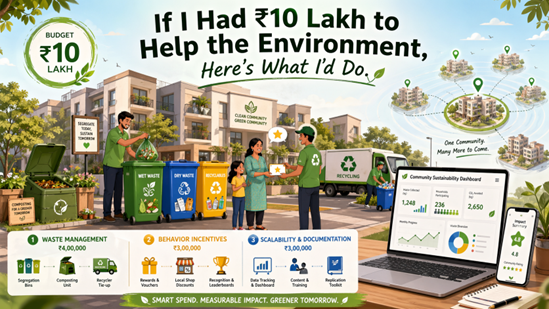
I would divide the ₹10 lakh into three main areas: waste, behavior, and scalability.
1. Waste Management: ₹4 Lakh
Around ₹4 lakh would go into setting up a small, hyper-local waste management system in one community—maybe an apartment complex or a small neighborhood. This would include proper segregation bins, composting units, and partnerships with recyclers. The goal isn’t to build something huge, but to create a working model that proves sustainability can be practical and efficient at a local level.
2. Behavior Change Through Incentives: ₹3 Lakh
Next, I’d spend about ₹3 lakh on incentives. People don’t change habits just because it’s “good for the planet.” They change when there’s a clear benefit. I’d create a reward system where households that properly segregate waste or reduce plastic usage get small but meaningful incentives—discounts at local stores, vouchers, or even public recognition. This taps into basic human psychology: we respond to rewards and social validation.
3. Documentation and Scalability: ₹3 Lakh
The remaining ₹3 lakh would go into documenting and scaling the idea. I’d build a simple website and create content showing the results—how much waste was reduced, how behavior changed, and what actually worked. This turns a small project into a case study that others can replicate. If one model works, it can be copied in 10, 50, or even 100 communities.
The key idea here is leverage. ₹10 lakh is not enough to fix climate change, but it is enough to build a system that can spread. Instead of trying to solve the entire problem, I’d focus on creating something that others can adopt and improve.
At the end of the day, sustainability isn’t just about big ideas—it’s about systems that actually work in real life. If we can make sustainable choices easier, rewarding, and scalable, even a relatively small amount like ₹10 lakh can create a ripple effect.
The real question isn’t how much money we have. It’s how intelligently we use it.