
Six SDLC Use Cases Where the Context Graph's Job Is Refusal
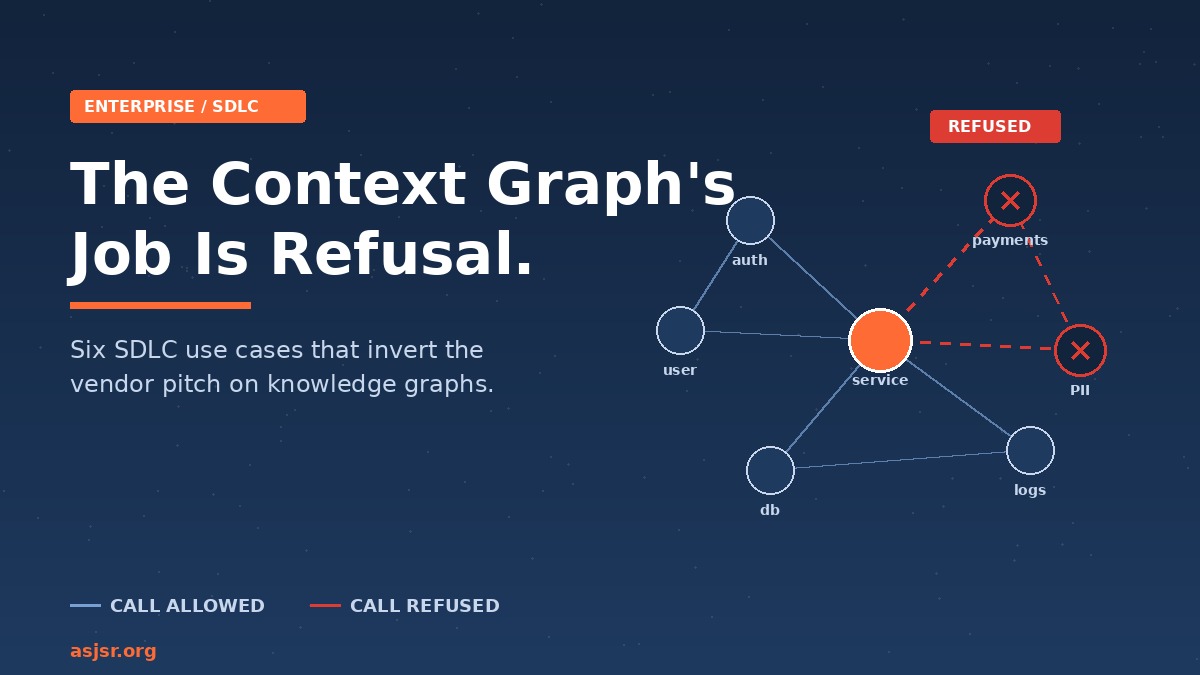
Six SDLC Use Cases Where the Context Graph's Job Is Refusal
Meta description: The enterprise SDLC context graph is not a brain for AI agents. It is a constraint layer. Six use cases reframe the buying decision around what the graph refuses, not what it retrieves.
The context graph's most valuable enterprise job is to say no. Vendors pitch the knowledge graph as the missing brain that finally gives coding agents enough context to ship production-grade code. That framing inverts the actual enterprise need. In a regulated SDLC, the graph's defining work is not expansion of what agents see, but restriction of what agents touch. Context, in the enterprise, is constraint.
The Inversion No One Sells
Walk into any vendor demo and the story is the same. A coding agent is struggling. The graph appears. Suddenly the agent knows the call hierarchy, the owner, the deploy dependencies, the test coverage. The agent ships. Everyone claps.
That demo answers the wrong question. Enterprise SDLC failures are not failures of agent context. They are failures of agent control. Gartner projects that by 2026 over 80 percent of enterprises pursuing AI initiatives will be using knowledge graphs to enhance context and reasoning. That number is real. The framing around it is not. The graph earns its budget when it stops bad changes, not when it suggests good ones.
Consider where enterprises actually lose money on AI-assisted development. Teams that exceed 40 percent AI-generated code see rework rates climb to 20 to 30 percent, costing roughly seven hours of waste per developer each week. The cost is not lack of context. It is unchecked action.
The six use cases below treat the graph as a constraint surface. Each one inverts a familiar pitch.
Use Case One: Blast Radius Before Bytes
An agent proposes a change to a shared utility function. The conventional pitch says: query the graph, surface the call sites, give the agent more context, let it adjust the patch. Useful. Not interesting.
The interesting use is to refuse the patch before generation. The graph returns 47 downstream services. Twelve are owned by teams that have not been notified. Three sit inside PCI scope. The agent's prompt is preempted. It does not write the code. It opens a coordination ticket instead.
This pattern flips a known asymmetry. Generation is cheap. Reverting a production incident is not. The graph is the brake, applied before the agent finishes its sentence.
Use Case Two: Provenance, Not Just Retrieval
Every agent commit deserves a decision node. Not a comment. Not a PR description. A typed node in the graph that captures: what prompted the change, which policy was checked, which approvals were granted, which prior decisions were referenced.
Cognition frames this directly, arguing that the context graph of code becomes the real source of truth for autonomy because it explains not just what happened, but why. The audit benefit is obvious. The operational benefit is sharper. When a regulator asks why a particular change shipped on a Tuesday in October, the answer is a graph traversal, not an archeology project.
The use case is not "help agents remember." It is "make agents accountable."
Use Case Three: Ownership as a Merge Gate
CODEOWNERS files are a flat approximation of a graph. They list humans, never the conditions around those humans. The context graph fixes that gap by encoding:
- Time-boxed reviewer rotations across squads
- Out-of-office and parental leave status from the HRIS
- SOX-restricted approvers for production-touching repos
- Cross-functional sign-off requirements for security-sensitive code
- Tenure thresholds for changes inside critical paths
The merge button becomes graph-conditional. An agent cannot ship a payment service change reviewed by an engineer who started last week, even if that engineer clicked approve. The graph rejects the merge based on the policy edge that ties tenure to risk class. Refusal travels at machine speed.
Use Case Four: Policy at the Edge of Every Agent Call
"Service A cannot call Service B." Today that rule lives in a Confluence page nobody reads. Sometimes it lives in a runtime mesh policy that catches the violation in production, three deploys too late.
The graph makes the rule a typed edge. Every agent action, before it generates a single line, runs a validation query against that edge. Calls that would create the prohibited link are refused at design time.
Harness describes the underlying mechanism as a code knowledge graph where nodes are functions, classes, modules, interfaces, and comments, and edges are relationships including calls, imports, inherits, implements, modifies, and tests. The vendor frames it as retrieval power. The enterprise frames it as policy substrate. The same graph supports both readings. Only one of them survives an audit.
Use Case Five: Drift as a First-Class Signal
Architectural drift used to be a quarterly slide deck. With agents committing daily, drift now happens hourly. The graph holds the declared architecture as a baseline. Agent-driven changes are compared against that baseline in real time.
The output is not a dashboard. It is an interrupt. When the drift exceeds a threshold defined per repo class, the next agent action is blocked until a human resolves the divergence. The graph stops the bleed before the architecture review board needs to schedule a meeting.
This is where the dominant retrieval pitch breaks down most visibly. A graph that only feeds context to agents drifts along with them. A graph that compares declared truth to observed truth refuses drift on contact.
Use Case Six: Write Boundaries for Multi-Agent Work
Six agents in one codebase is no longer a research scenario. OriginTrail describes coding agents running on Cursor, Claude Code, and Codex coordinating through a shared context graph structured into sub-graphs for code, decisions, sessions, tasks, and external PR sync. The collaboration story is real. The unspoken risk is collision.
The use case the vendor pitch ignores is the write boundary. The graph locks subgraphs at the entity level. Agent A holds a write lease on the payments module. Agent B's attempt to touch the same module is refused until the lease expires or transfers. Coordination by refusal beats coordination by hope.
The same model handles cross-agent priority. A security-classed agent's writes preempt feature-classed agents on the same node. The graph adjudicates. No human moderator required.
What This Means for Buying Decisions
The dominant buying question is "how does your graph help our agents code faster?" That question is a trap. It biases toward vendors who optimize for retrieval throughput and pretty traversals. It selects for demos, not for production.
The better question is "what can your graph prevent?" That question forces vendors to talk about:
- Policy enforcement at agent-action time, not after deploy
- Refusal latency under load with thousands of concurrent agent queries
- Audit-grade provenance retention with immutable decision history
- Failure modes when the graph is stale or partial
- Integration with existing approval, identity, and risk-class systems
Most vendor decks have nothing to say on these axes. That gap is the diagnostic. Larridin reports that healthy AI-assisted code shows under 12 percent churn at 30 days, and anything above 25 percent is critical. The graphs that move that needle are the ones engineered to refuse, not just to recommend.
The Word "Context" Was Always Wrong
Context implies more. The enterprise need is less. Fewer unsafe writes. Fewer unreviewed merges. Fewer policy violations slipping through at agent speed. Fewer architectural drifts surfacing only at the next audit. The graph that finally earns its budget is the one whose answer to most agent requests is refusal.