One Nation, One Election: A High School Student’s Perspective
One Nation, One Election: A High School Student’s Perspective
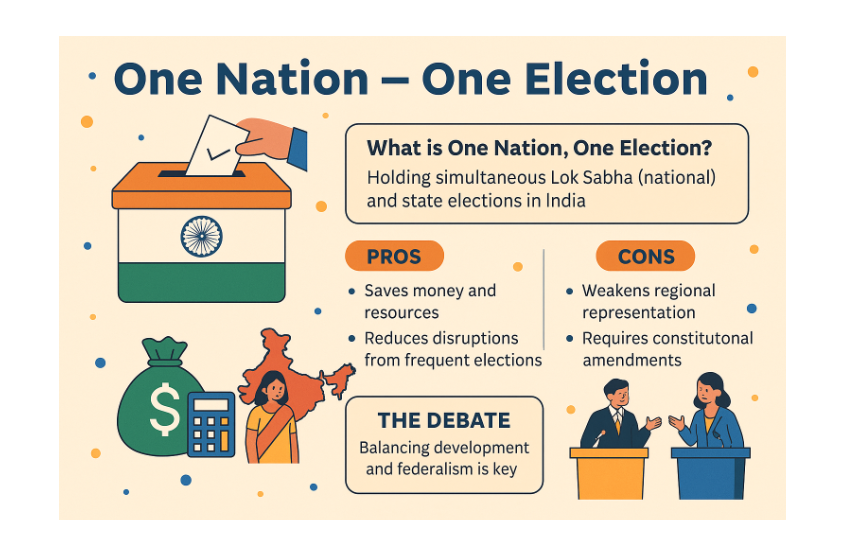
As a high school student trying to understand the politics of my country, the concept of “One Nation, One Election” (ONOE) seems both exciting and a bit confusing. At its heart, ONOE is a proposal to hold Lok Sabha (national parliament) and state assembly elections at the same time, rather than spreading them out over the years—as has been common since the late 1960s.
Historically, India did conduct simultaneous elections: in 1951–52, 1957, 1962, and 1967, the national and state elections were held together. But this system got disrupted due to early dissolutions of state assemblies and the Lok Sabha in the late 1960s and 1970s, leading to a spread-out election schedule.
As students, we often joke about how election season drags on forever—voting here, campaigning there—ONOE promises to change that. Proponents argue that having one big election every five years would save money, reduce the administrative burden, and ensure the government isn’t stuck in campaign mode often. BJP leaders say it could even boost India’s GDP by around 1.5% by reducing disruptions and focusing more on development.
For high school students like me, that sounds promising. Fewer disruptions mean our school’s infrastructure—like electricity, construction, and exam schedules—wouldn’t be frequently affected by the Model Code of Conduct, which freezes government projects during election periods. I remember how last year, during mock elections and parent–teacher meetings, discussions often veered off to campaign-related delays.
However, ONOE isn’t without criticism. Opponents, including regional and opposition parties, worry that such simultaneous polls could weaken the federal structure of India, making regional issues get overshadowed by national narratives. Leaders argue this system might favor big national parties while sidelining local voices. As a student learning about India’s diversity, this seems like a valid concern. After all, my classmates from smaller states often feel that local issues—like education policies or environmental concerns—get lost in big national debates.
ONOE’s implementation would need significant constitutional amendments, requiring two-thirds parliamentary majority and ratification by at least half the states. Just recently, in September 2024, the Union Cabinet approved the idea, and a bill was introduced in Parliament in December of the same year.
As a high schooler, watching this unfold in class discussions, debates, and social studies, I see ONOE as more than politics—it reflects the student in me who craves stability, transparency, and efficiency. But I also understand the need to ensure fairness, regional representation, and respect for India’s federal character.
ONOE can either carve out a new, streamlined chapter in India’s democracy or risk sidelining regional voices. As I approach voting age, I hope decisions like these consider both development and diversity, ensuring every student, every region, and every future voter feels heard.
```