
The Man Who Broke Thailand's Economy — And the Lesson Every Developing Nation Still Hasn't Learned
The Man Who Broke Thailand's Economy — And the Lesson Every Developing Nation Still Hasn't Learned
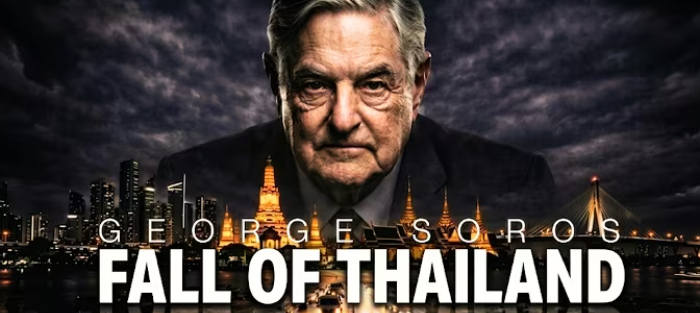
What happens when a single private investor decides to bet against an entire country's currency — and wins? In 1997 George Soros answered that question. The country was Thailand. The instrument was the Thai baht. And the consequences reshaped the economic history of an entire continent.
Who Is George Soros?
George Soros was born in Budapest in 1930. He survived the Nazi occupation of Hungary, emigrated to England and studied at the London School of Economics under philosopher Karl Popper — whose theory of reflexivity shaped Soros's entire investment philosophy. He founded the Quantum Fund in 1973 and by 1992 had already made history by shorting the British pound — earning an estimated $1 billion in a single day and the nickname "the man who broke the Bank of England."
His core investment idea was simple but powerful — markets consistently misprice assets. When the gap between market perception and economic reality becomes large enough the correction is inevitable. The speculator's job is to identify that gap and bet on the correction before the market forces it. Thailand in 1997 was that gap — made visible.
The Weapon Nobody Teaches You About
Some countries fix their currency's value to another — usually the US dollar — to create stability. This is called a currency peg. It sounds stable but contains a hidden vulnerability. To maintain the peg a central bank must hold enough foreign exchange reserves to buy its own currency whenever someone tries to sell it. If reserves run out the peg collapses.
A speculator who wants to break a peg follows three steps. First — borrow large amounts of the target currency. Second — sell all of it immediately, forcing the central bank to spend reserves buying it back. Third — wait. When reserves run out and the peg breaks the currency collapses. The speculator buys it back cheaply, repays the loan and pockets the difference. The bigger the collapse the bigger the profit.
Thailand's Hidden Vulnerability
Thailand's GDP grew at 8–12% annually through the late 1980s and early 1990s — part of what the IMF and World Bank celebrated as the "Asian economic miracle." But three fatal vulnerabilities were accumulating underneath.
- By 1996 Thailand's current account deficit had reached 8% of GDP — $14.7 billion — a level the IMF considers to merit close monitoring according to the Congressional Research Service
- Corporate Thailand owed $70 billion in US dollar-denominated debt
- 40% of all bank loans were real estate-related — with Bangkok office vacancy rates hitting 15% by 1996
The economy was overheating and the baht was pegged at a rate that no longer reflected reality. Since 1996 Soros's Quantum Fund had been quietly borrowing baht and converting it into dollars — building a position that would bring the entire system down.
The Attack
By May 1997 Soros began massive short positions against the baht. He borrowed baht at Thai interest rates of 12.5% versus US rates of 5.5% and sold aggressively across spot and futures markets. The Bank of Thailand fought back — spending reserves, raising interest rates and deploying $12 billion in a joint intervention with Singapore. It worked temporarily.
Soros returned with more firepower — attacking Thailand's stock market, foreign exchange market, futures market and derivatives market simultaneously. Thailand's reserves fell from $32 billion in 1996 to just $2.8 billion by July 1997 — enough to cover two weeks of imports according to Global Wealth Insight.
On July 2 1997 Thailand abandoned the peg entirely. The baht collapsed from 25 to the dollar in June 1997 to 54 by January 1998. Soros converted $1 billion into 54 billion baht then used forward contracts to convert it back into $2 billion — doubling his money on a single trade according to Valdosta University research.
The Human Cost
The consequences were devastating. According to a peer-reviewed ResearchGate paper, Thailand's GDP growth fell to -2.8% in 1997 and -7.6% in 1998. Thailand's nominal GDP per capita dropped 21.2% between 1996 and 1997 according to the Corporate Finance Institute. Unemployment rose 50% to 1.5 million people. The absolute number of Thais in extreme poverty increased from 6.8 million to 7.9 million in two years according to the World Bank.
The crisis spread to Indonesia, Malaysia, the Philippines and South Korea. The IMF and World Bank poured $118 billion into the affected economies. Thailand's bailout alone was $17 billion — attached to austerity conditions critics argued worsened the human cost rather than relieving it.
The Uncomfortable Truth
Most accounts blame Soros and stop there. The honest economic analysis is more complicated. Soros himself argued the vulnerabilities were already there — that speculators simply identified and accelerated an inevitable correction. Senior US diplomats who managed the crisis recorded a similar view. Thailand's banking system, crony capitalism and over-leveraged economy would have collapsed regardless of speculative pressure.
Soros did not create Thailand's vulnerability. He exploited it. That distinction matters — because it shifts the lesson from "speculators are dangerous" to something more actionable. Structural economic weakness is the real threat. The speculator simply arrives with a match when everyone else is pretending the fuel isn't there.
Why This Still Matters
India's net FDI stayed negative for eight of the thirteen months between January 2025 and January 2026 according to Business Standard. The rupee hit ₹96 to the dollar in 2026 — an all time low — with the RBI spending reserves to defend it. India is not Thailand in 1997. Its economy is far larger and its currency is not pegged. But the underlying lesson is timeless — any economy that looks stronger on the surface than its fundamentals justify is carrying a vulnerability someone somewhere is already calculating.
The man who broke Thailand's economy didn't use missiles or sanctions. He used a spreadsheet and a phone call. That is the most important economics lesson nobody teaches in school.
Sources
- ResearchGate — Thailand During the Asian Financial Crisis (peer-reviewed 2024)
- Corporate Finance Institute — Asian Financial Crisis Overview
- World Bank — Social Consequences of the East Asian Crisis
- Congressional Research Service — The 1997-98 Asian Financial Crisis
- Valdosta University — Lessons From Thailand's 1997 Financial Crisis
- Business Standard — India FDI data 2026